
On the receiving end...
While the dredger has been making its way down the arm removing silt and the other rubbish on the bottom of the canal, two tugs have operated a near continuous relay shunting the barges of silt to Highline Boatyard and bringing the empties back to the dredging site. This is a look at the work being done at Highline to keep the dredger working.
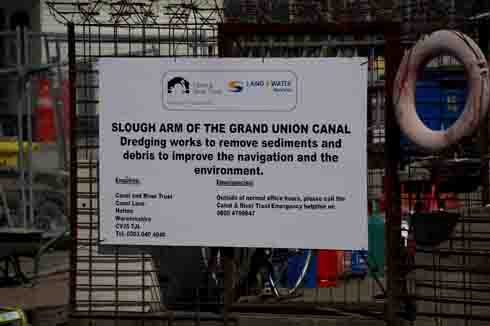
A sign at the yard confirms that this work is a partnership between Canal and Rivers Trust and Land and Water.
Another long armed digger is located at the water’s edge and is capable of reaching most of the way across the canal. Road vehicles can back up to the digger

The essential operation here is to empty the contents of the barges into road vehicles for transfer to the disposal site.
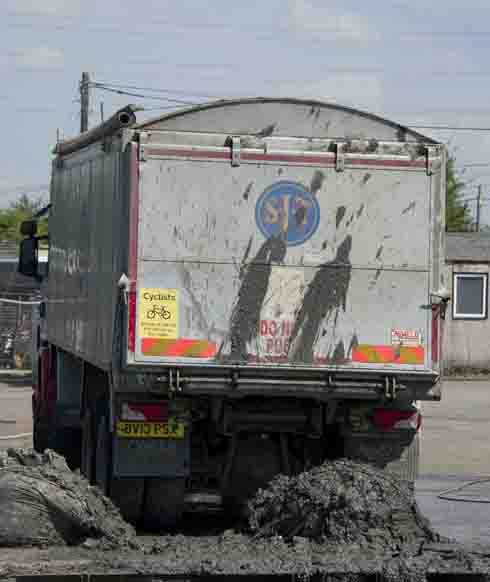
Facts and figures from the project leader are that each barge equates to two and a half lorries; at their busiest there have been 15 lorry loads each day; the lorries average 1.7 round trips per day, so the ones that leave early in the morning get back for a second trip the same day, although some are also diverted if they have the chance of moving a second load somewhere on their return trip.

The process begins when one of the tugs arrives with a loaded barge. They slow right down to pass the residential moorings. Note the tugs attach themselves to the rear of the barge, using a fender at the point of contact and attaching a steel cable to each side of the barge. The two cables are pulled tight by a winch mechanism which keeps the tug and barge in line.

One of the drivers explained to me that they prefer the pushing configuration as the whole assembley behaves as one rigid boat which is easier to steer, the combination is easier to control if there is a need to stop quickly.
The tugs bring the barges to within reach of the digger and release their connection. Fine positioning of the barge is done by the digger operator who can push the barges around with the digger arm.

The digger can then scoop the silt out of the barge and load it into a lorry for transfer to the site at Peterborough.

The lorries have an automated cover so the silt is sealed in before they go out onto the road. Spilt or splashed muck on the lorry is washed off before they leave the site and go into public space.
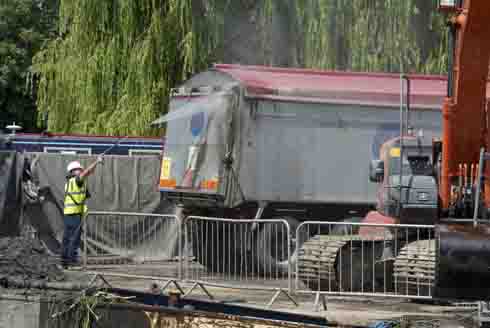
On a good day the next lorry is waiting to back up to the digger so the transfer process can keep pace with the dredging. At the most extreme when dredging was near the basin, the tug drivers said a round trip to deliver an empty barge and bring back a full one took just over two hours.
